
Foot Care – Posterior Heel Pain
Pain in the back of the heel and just above the heel is usually caused by one of the following conditions:
Haglund’s Deformity (“Pump Bump” is a bony enlargement of the upper/back portion of the heel. This enlarged bone rubs on the Achilles Tendon, just above its attachment to the heel, causing inflammation and pain.
Retrocalcaneal Bursitis is an inflammation of the protective sack between the heel bone and the Achilles tendon.
Calcification of the Achilles Tendon at its attachment to the heel.
Achilles Tendonitis is an inflammation of the Achilles Tendon.
All four of these conditions are caused by a biomechanical problem with the foot (a defect in the foot’s structure or function).
Anatomy of the Back of the Heel: The Achilles Tendon travels down from the lower portion of the calf and attaches to the middle of the back of the heel (the posterior aspect of the heel).
A fluid-filled sac called the Retrocalcaneal Bursa exists to prevent the top portion of the heel bone (the superior aspect) from rubbing against the Achilles Tendon.
This bursa, or protective sac, lies between the posterior-superior aspect of the heel and the Achilles Tendon, preventing the heel bone from rubbing against the tendon’s soft tissue.
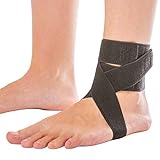
- UNIVERSAL DESIGN – One size fits most, accommodating ankle circumferences up to 12 inches. Please measure before purchasing. Wear on your right or left foot.
- DAYTIME PAIN RELIEF – Plantar fasciitis night boots for sleeping stretch your plantar fascia, but heel pain often returns during the next day. This brace provides compression to your plantar fascia and Achilles tendon, supporting your foot arch and ankle.
- FOOT AND ANKLE SUPPORT – Helps with plantar fasciitis, Achilles and peroneal tendonitis, posterior tibial tendon dysfunction (PTTD), fallen or high arches (arch posture), sprains, rolled ankles, and mild instability.
- FITS IN SHOE – This plantar fasciitis day support is small, lightweight, and easy to move with. Designed to fit inside your shoe without adding bulk.
- MEDICAL-GRADE QUALITY: Our wrap is made with the highest quality fabric that can be exposed to sweat and water without any added discomfort or damage. Safe to wear in the shower or pool.
Last update on 2026-10-12 / Affiliate links / Images from Amazon Product Advertising API
Posterior Heel Pain – Causes & Predisposing Factors
Causes: If the posterior-superior portion of the heel has an abnormally large bony prominence (called a Haglund’s Deformity), it may sometimes rub against the Achilles Tendon.
When this occurs, the bursa between the bone and the tendon will become inflamed, swollen, and painful. This condition is called Retrocalcaneal Bursitis.
The presence of Haglund’s Deformity does not ensure that these problems will occur. For them to occur, the heel and foot must be tilted to force this bony prominence into the bursa and tendon.
The most common cause of heel tilting is flat feet. When the arch is flat, the front of the heel bone is tilted lower than normal, while the back of the heel is tilted a bit higher.
This may force the posterior-superior portion of the heel into the Retrocalcaneal Bursa and Achilles Tendon.
High arches. When this occurs, the front of the heel bone is tilted upwards, while the back of the heel is tilted down and back. This may force the posterior-superior portion of the heel into the Retrocalcaneal Bursa and Achilles Tendon.
Pronation. Pronation is a tilting or rolling out of the foot so that we are forced to walk with more of our weight on the inner aspect of the heel and foot.
When this occurs, Haglund’s Deformity presses with abnormal force against the inner portion of the Retrocalcaneal Bursa.
Pronation frequently occurs in flat feet, increasing the occurrence of heel pain.
Supination
This is the opposite of pronation. The foot rolls inward, forcing us to walk with more of our weight on the outer aspect of the heel and foot.
When this occurs, Haglund’s Deformity presses with abnormal force against the outer portion of the Retrocalcaneal Bursa.
Supination frequently occurs in high-arched feet, increasing heel pain. (Pronation affects the feet much more frequently than supination).
Tight or short Achilles Tendon.
This condition may be due to a genetic or congenital cause ( such as during development, lying in the uterus in such a way as to restrict the normal development of this tendon); injury to the tendon, a result of surgery on the leg; strokes; and other neuromuscular diseases.
The result of a tight Achilles Tendon is to pull up on the back of the heel, where it attaches, with such force that the back of the heel cup raises and tilts, forcing the heel into the Retrocalcaneal Bursa.
At the same time, the increased pull of this shortened tendon may produce a generalized inflammation of the tendon at or near its attachment to the heel.
Thus, the net effect is Retrocalcaneal Bursitis and Insertional Achilles Tendonitis.
The above process may be hastened if the shoe heel counter rubs against the skin on the back of our heels with too much pressure.
Posterior Heel Pain – Custom Treatments
Treatment: Long-term Treatment must be directed towards eliminating the abnormal tilting of the heel, regardless of its cause.
If this is delayed, the usual results are: the pain and swelling become worse, chronic, and debilitating, and eventually, painful calcifications and bone spur formations may occur on the back of the heel, along with tears in the Achilles Tendon.
These serious problems may require surgical intervention.
The foot must be rebalanced to eliminate abnormal heel tilt. This is best accomplished by controlling and reducing the biomechanical foot defects causing the heel to tilt.
Custom-made orthotics are the “Gold Standard” of medical care, the treatment most used by doctors and therapists to eliminate pain, inflammation, and swelling at the back of the heel.
Custom-made orthotics comfortably re-balance the feet and overcome the biomechanical foot defects that cause heel tilt and pain.
How Custom-Made Orthotics Work: Custom-made orthotics are made of “space-age”, comfortable, thermoplastic materials that will help provide years of pain-free walking.
Advanced technology enables orthotics to gently maintain the heel in its neutral position (stabilizing it), thus helping to eliminate heel tilt.
When the heel no longer tilts and rubs against the Retrocalcaneal Bursa and Achilles Tendon, these structures can heal, and walking becomes “fun” again!
Stabilizing the heel will also help reduce ankle sprains, plantar fasciitis, and heel spurs on the bottom.
By adding appropriate lifts to the heel, custom-made orthotics will help to eliminate the pain caused by a short Achilles Tendon.
In addition, comfort is provided to the arch, shins, knees, and lower back by using “space-age” materials.
These unique materials provide semi-flexible support to the arch by “giving” to absorb the shock of each step, rather than our foot absorbing the shock (our orthotics act the same way a shock absorber does on an automobile).
When your weight is removed from the orthotic, the arch returns to its original height since our material has a built-in “memory.”
Last update on 2026-10-12 / Affiliate links / Images from Amazon Product Advertising API
Posterior Heel Pain – Non-Custom Treatments
The following product can be very effective in reducing pain in the back of the heel; however, it does not correct the underlying cause of this problem as custom-made orthotics do.
Foot PathologyAchilles Heel Guard: This product, more than any other, comfortably protects the back of the heel and the lower portion of the Achilles Tendon from shoe pressure and friction.
It is the only product that protects these areas without slipping.
It comprises a comfortable elastic sleeve with a long-lasting gel cushion designed to absorb pressure and friction rather than allowing these forces to “work” on the skin and soft tissue.
The gel cushion is thin enough to fit in any shoe, yet it is durable and will provide comfort for many months. The entire guard, including the gel cushion, is washable.
The circumference of your ankle determines size.
This is measured with a tape measure placed around the ankle.
Posterior Heel Pain – Self-Help Treatments & Exercises
The following may give some immediate relief, but usually not permanent relief:
Wear open-back shoes with a higher heel. This will eliminate some pressure on the back of the heel.
Applying ice to the back of the heel may help reduce inflammation and pain.
It would be best to have mild cooling; you do not want to freeze the area. If the area becomes too cold, it may increase the pain.
Apply an ice pack over a sock, not directly against the skin. Use for 10 minutes at a time, several times a day.
If the cold makes the pain worse, stop immediately. Diabetics and those with poor circulation should not use ice.
A gentle massage with a cold liquid may help.
If it is comfortable, sleep with your heel not touching the mattress. Before sleep, put a pillow under your calf to help elevate the heel.
This will help to keep pressure off of the heel.
Finally, if you have an open sore, ulcer, or infection or think you may have a tendon tear, see your family doctor immediately!
Achilles Heel Guard
Podiatrists and orthopedic specialists use this product more than any other to comfortably protect the back of the heel and the lower portion of the Achilles Tendon from shoe pressure and friction.
It is the only product that protects these areas without slipping.
It comprises a comfortable elastic sleeve with a long-lasting gel cushion designed to absorb pressure and friction rather than allowing these forces to “work” on the skin and soft tissue.
The gel cushion is thin enough to fit any shoe, yet it is durable and will provide comfort for many months. The entire guard is washable, including the gel cushion.
The circumference of your ankle determines size. This is measured with a tape measure placed around the ankle.


