Plantar Fasciitis – Self-Help Treatments and Exercises
The following self-help treatments are most effective when used in conjunction with Custom-Made Orthotics or other helpful products:
•Rest your foot. Reduce the amount of weight-bearing activities you participate in. Get off of your feet and elevate them. This will allow healing to begin.
•Apply ice to your foot. Applications of ice packs that provide a comfortable cooling to the heel and arch (not a cold) will help reduce pain, swelling, and inflammation. Apply the ice to the heel and arch (not the toes). Make sure it is comfortable, and leave it on your foot for about 20 minutes, three times a day.
If you have any medical problems such as diabetes, poor circulation, etc., discuss the use of ice with your doctor before applying the ice.
•; Do not walk with bare feet. Always protect your heels, arches, and plantar fascia with good supportive shoes.
•Stretch the Plantar Fascia while sleeping. Plantar Fasciitis and Heel Spur pain is usually worse in the morning’s first steps. This is due to the Plantar Fascia tightening up, or contracting while we sleep. To prevent these pain producing contractures of the plantar fascia, the foot must be held in its normal or neutral position while we sleep. Our comfortable and supportive Night Splint maintains this optimal position of the foot.
When foot contractures are prevented during sleep, the “first step pains” Plantar Fasciitis and Heel spur will gradually subside. For more information about this uniquely effective and comfortable night splint,
•Stretch the Plantar Fascia during the day. Even though the Plantar Fascia is a thick tissue band with very little “give” to it, with the proper care (a Night Splint and the following exercises) it can be stretched a small amount. By stretching the Plantar Fascia even a bit, its abnormal pull on the heel is reduced. This will help to reduce pain and inflammation in the heel and arch.
Two of the most effective exercises recommended are:
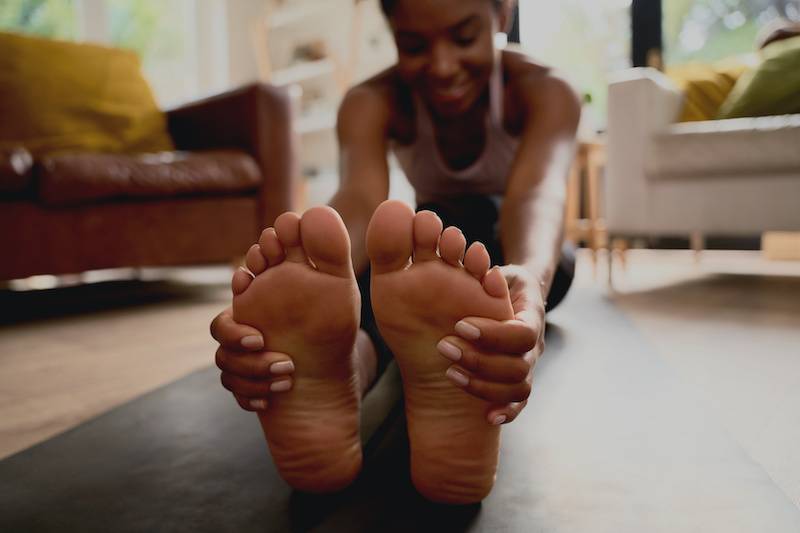
Before stepping down, especially after sleeping or resting, stretch the foot’s arch by stretching your legs out in front of you (do not bend the knee). Place a towel around the ball of the foot. Slowly pull on the ends of the towel, pulling the toes and ball of the foot back as far as is comfortable. Hold the foot in this position for ten seconds. Repeat at least ten times. You should feel a pull on the bottom of the foot, especially in the arch. This stretches the plantar fascia and reduces its pull on the heel.
Repeat at least ten times, and try to do this three times a day.
If you are unsure of the nature of your foot problem, if your pain is intense and does not subside, if you are a diabetic or have other medical problems, if your pain is due to an injury, if an open sore is present, if a mass can be felt, or if you think that you may have an infection, we suggest that before beginning any of the above treatments you consult with your family doctor.
Plantar Fasciitis Self-Help Treatments
There are several ways to help cure plantar fasciitis. You can try stretching your calf, low-impact exercises, TENS therapy, or even use an orthotic insert to alleviate the pain. You should use self-help treatments to heal your foot pain regardless of your treatment option. These techniques may not be the best for you, but they may help you feel better sooner.
Stretching your calf
A simple towel exercise is one easy exercise to stretch your calf for plantar fasciitis. Place the towel on the back of your heel and pull it towards you while sitting or standing. Hold this position for fifteen to thirty seconds and alternate sides. This exercise is especially helpful when you wake up in the morning or after a period of rest. It can be done as many times as necessary to reduce your pain.
Various stretches are useful in relieving the pain and improving your foot and ankle’s function. These stretches can be done with just about anything that can be held still for a few seconds. You can also try standing in a comfortable position with your legs together, or you can lean forward and grab a wall. Either way, hold the stretch for at least 10 seconds and repeat a couple of times to improve your flexibility.
Low-impact exercises
One of the most effective low-impact exercises for plantar fasciitis is rowing. Rowing machines involve pulling on a handle to turn a flywheel. Kayaking or rowing in a boat is a very low-impact exercise for the feet. To get started, visit your local lake or park and rent a kayak or rowing boat. While elliptical machines are also lower-impact than treadmills, they can cause pain in sensitive feet. If this is the case, try a different type of cardiovascular workout.
If conservative treatment doesn’t work, you can opt for physical therapy. Your physical therapist will work to strengthen the plantar fascia and stretch the Achilles tendon and lower leg muscles. Surgery may be an option depending on the severity of your plantar fasciitis.
Yoga, for example, is a popular low-impact exercise that doesn’t involve running or jumping. Instead, yoga emphasizes stretching and strengthening muscles in the lower leg. A simple ice bath can help reduce inflammation and pain.
TENS therapy
TENS therapy for plantar fasciitis has been around for many years, but it has only recently gained much acceptance in clinical practice. The benefits of TENS are still unclear. The mild results may be the result of placebo effects. That said, this technique can potentially treat many conditions, including SCI and neuropathic pain. Therefore, it is worth considering if TENS can provide relief for you.
A meta-analysis found that TENS does not seem as effective as other forms of treatment. The results of a large number of controlled studies that compared TENS to non-invasive treatments were not conclusive. Moreover, there were no controlled trials comparing TENS to placebo in chronic pain. In addition, only one study assessed the effectiveness of TENS and exercise alone. Another study compared TENS to electro-acupuncture.
Orthotic inserts
In addition to visiting a foot care professional to get prescribed treatment, you can also try out several Plantar Fasciitis Self-Help Treatments with orthotic inserts. Custom orthotics may be necessary, especially if you have faulty biomechanics. In severe cases, wearing orthotics may be necessary for the rest of your life. Custom orthotics costs may run you up to $800, but many people find them worthwhile for their symptoms.
There are two types of insoles: custom-molded ones and over-the-counter ones. Both have their advantages and disadvantages. According to Dr. Jacqueline Sutera, a podiatrist in New York, it is best to start with an over-the-counter treatment option and then move to a custom-fitted insole if the condition persists or worsens. Orthotic insoles have two basic characteristics: volume and arch support.
A high-volume insole is designed for a high-arched foot, while a medium-volume one is designed for an arch type.