Foor Problems – Bunions
Description: The medical terms used to describe a bunion are Hallux Valgus and Hallux Abducto Valgus. A bunion is a complex deformity that results in:
A bump that develops on the inner side of the foot, in the area where the big toe and the bone it connects to (called the first metatarsal) meet.• The turning inward of the big toe, so that it presses against the second toe (the big toe is no longer straight).
Bunions are a progressive deformity, and if left untreated the bump will become larger, and the big toe will eventually lie over or under the second toe.
Causes of Bunions: The normal foot is made up of bones and joints which are held tightly together, in a precise relationship. In order for a bunion to form, the ligaments and tendons which hold the bones and joints together must be more flexible than normal.
This abnormal flexibility is usually the result of a biomechanical foot defect called pronation, which destroys the normal relationship between the big toe and the first metatarsal. Pronation is caused by either the genes we inherit or the way our feet lie against the uterine wall prior to our birth. Pronation is a turning outward of the foot at the ankle so that one has a tendency to walk on the inner border of the foot.
When this occurs, we walk with an abnormal amount of our weight being forced on the big toe and first metatarsal. The result is a bump on the inner side of the foot, and a big toe that is pushed over toward the second toe. When flat feet occur along with pronation, the foot becomes even more flexible and susceptible to bunion formation. Bunion progression may be hastened by:
Wearing high heels and pointed-toe shoes. These types of shoes apply abnormal pressure to the big toe and force it over toward the second toe; they also irritate the first metatarsal head causing a bump to form (when a bone is irritated it enlarges)
An injury to the inner side of the foot or big toe may damage the first metatarsal phalangeal joint, and speed up bunion formation.
Arthritis of the first metatarsal phalangeal joint may cause the joint to become enlarged, and a bunion may then form. Some neurological diseases cause contractures of the joints of the feet and toes, helping bunions to form.
Nonsurgical Solutions For Bunions
If you are having problems with your big toe, you may be wondering how to deal with bunions. If left untreated, this condition can lead to arthritis of the metatarsophalangeal joint, the joint that connects the big toe to the rest of your foot. Thankfully, there are nonsurgical solutions for bunions, as well as surgical procedures that realign the toe. Read on to learn about nonsurgical solutions for bunions, as well as the different treatments available.
Nonsurgical bunion treatments
Nonsurgical bunion treatments can relieve the pain and discomfort caused by a bunion and slow its progression. These methods do not, however, fix the misalignment of the foot bones and can only help to reduce the severity of the condition. While surgery is sometimes necessary, it is rarely necessary for the patient’s condition. The type of surgery required depends on the condition of the patient’s foot, age, and anatomy. There are several different procedures that can correct a bunion.
Surgery to realign the toe
One option for surgical toe realignment is bunion surgery. If noninvasive therapies fail to correct the bunion, it is likely to progress to surgery. During bunion surgery, various types of internal fixation are placed inside the foot. Surgery may not correct the bulge entirely but can realign the toe and reduce the height. This procedure may also be combined with other procedures, such as podiatric care.
X-rays
When bunions occur, x-rays can help doctors predict the likelihood of recurrence. The results of these studies suggest that X-rays of non-weight-bearing x-rays can accurately predict the risk of recurrence. In addition, bunions can be treated by surgical screws that correct the bunion deformity. After surgery, the doctor may apply screws to the foot or place pins or staples on the foot.
Symptoms
Bunions occur most often in adult women but can occur in tweens and young teenagers as well. In fact, teenage girls are three times more likely than boys to develop bunions. It’s also common for men to develop bunions in their forties, but women are more likely to have them than men. One of the first signs of bunions is a bump on the inside of the foot about one inch below the big toe. However, a doctor needs to be consulted immediately if the bumps or signs do not seem normal.
Causes
Conservative treatments for bunions may include wearing properly fitting shoes and taking anti-inflammatory medications. These methods are meant to minimize symptoms and may not cure the condition entirely. However, they may help you get back to your regular activities. Here are some of the best ways to deal with bunions. Some non-surgical treatments for bunions include wearing wider shoes and sandals. Avoid high-heeled shoes if possible. Taking anti-inflammatory medication and local cold-pack applications can help ease the pain and inflammation.
Treatment of Bunions: Long-term treatment should be directed towards re-balancing the foot so that we no longer walk with our weight forced onto the inner border of the foot. This is accomplished by controlling and reducing pronation with the use of custom-made orthotics. When designed correctly, custom-made orthotics comfortably re-balance the feet and overcome pronation.
This reduces the abnormal weight forces on the big toe and its metatarsal head, allowing the feet to function normally. As a result, the deformity should not worsen, and the pain should gradually subside. If the foot is not re-balanced, the deformity and pain will become worse.
Custom-made orthotics, which will fit in any shoe with a heel height of 2 inches or less, Short term pain relievers include the following:
A Toe Alignment Splint will prevent further movement of the “big toe,” in addition to straightening it. A soft, long-lasting Silopad Gel Bunion Shield can be worn in your everyday shoes.
Wear wider and flatter shoes, with a rounded toe. Massage with a cool linament.
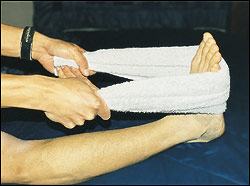
Exercise the toe. With your hand, move the toe up and down, and bring it out, as far as is comfortable for 3 to 5 minutes daily. If this becomes painful, stop immediately.
If you ever experience open sores, extreme redness, or extreme pain, see a podiatrist immediately.